

One of the things I appreciate about Popular Mechanics is that they realize there are different levels of handy. While their tool and gear reviews feature pro-caliber equipment, they get that not every suburban homeowner needs—or can afford—a $700 circular saw. So they almost always include a “Best Budget” category for those of us with shallower pockets and less demanding chores.
Such was the case in a recent issue, where the editors rated the best pocket knives. The knife rated Best Overall was the $60-ish Kershaw Iridium. A fine piece of craft, I’m sure, but I’ve previously explained why I am EXTREMELY reluctant to pay more than $30 for a knife. (CliffsNotes version: I lose them.)
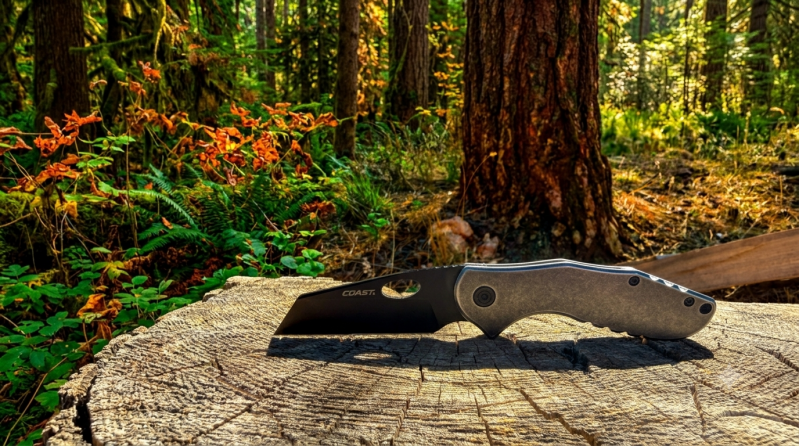
PM’s budget pick was something called the Coast Contra. I wasn’t very familiar with the Coast brand, but at the $30 price point, I was interested enough to give it a try.
My local hardware store didn’t carry the brand, so I looked on Amazon. Sure enough, they had the exact knife for $27. I clicked Buy Now, and two days later the knife arrived.
The first thing I noticed when I took it out of the box was its heft. Some inexpensive knives feel clunky or flimsy, but this one had both substance and balance. It just felt good in my hand. I knew from the Popular Mechanics article that the blade was a Wharncliffe style—not my usual preference, but I could live with it. The Wharncliffe has a nearly straight cutting edge and is particularly good for slicing and utility chores, which turned out to make a lot of sense for the way I use a pocket knife.
The Contra opened smoothly with the flipper and locked securely into place with its frame lock. It felt surprisingly solid for a knife that cost less than $30. The blade is 7Cr17 stainless steel—not exotic, certainly, but perfectly respectable at this price point—and it was plenty sharp right out of the box.
I've carried that knife for 60 days now, working in the garage, around my yard, at the community garden, and at my off-grid mountain camp. It has opened packages, cut cord, trimmed plastic, shaved kindling, sliced fruit, and performed all the other miscellaneous chores typically expected of an EDC pocket knife.
It took everything I threw at it and came back for more.
As you might expect with 7Cr17 steel, it became noticeably less sharp after the first 30 days. But this is where inexpensive steel has an advantage. I put it to the whetstone and, as you would also expect, it sharpened easily. It didn't require any special equipment or a degree in metallurgy—just a little time and patience.
There are better pocket knives than the Coast Contra. There are knives with better steel, more sophisticated locking mechanisms, lighter materials, tighter tolerances and considerably more impressive pedigrees. You can spend $100, $200 or more on a pocket knife if that's your thing.
But I'm not sure I need to.
For about $30, the Coast Contra gives me a solid, well-balanced knife that opens smoothly, locks securely, carries comfortably, and can handle every cutting chore I’m likely to encounter. And if I lose it—which, given my history with pocket knives, is always a distinct possibility—I won't have to spend the next week retracing my steps while muttering obscenities.
After 60 days, I've found the Coast Contra to be exactly what Popular Mechanics said it was: a decent everyday-carry knife for the money.
For guys like me, that's a pretty high recommendation.
Add comment
Comments