

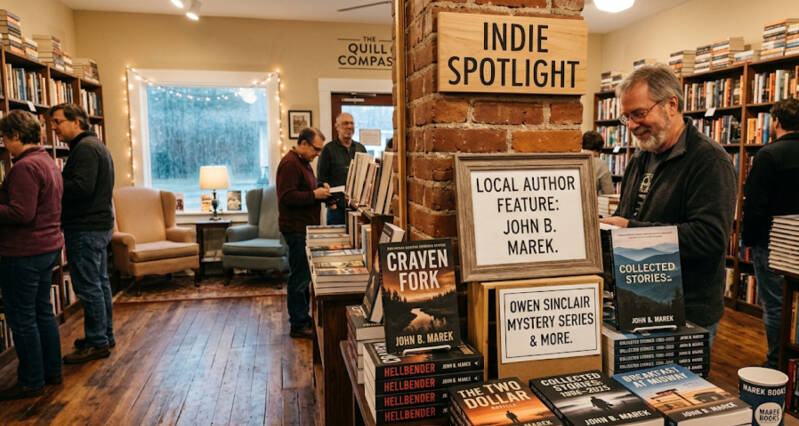
I've spent enough Saturday afternoons behind folding tables at independent bookstores to have picked up a few things, mostly by watching the owners and staff wince in real time. Nobody complains out loud. Indie booksellers are, as a rule, too polite and too tired for that. But the wince tells you everything.
Here, in no particular order, are five things that make indie bookstore folks want to lie down in the stockroom for a while.
1. "I'll just get it on Amazon."
Said out loud. In the store. While standing next to the book.
I understand the instinct. Convenience is a powerful drug, and free two-day shipping has rewired a whole generation's sense of how commerce should feel. But there's something particular about announcing it inside the very shop that ordered the book, shelved the book, and is currently holding the book in its hands for you. It's a bit like test-driving a car and then buying a different one from the dealership across the street while the salesman is still standing there.
Most indie stores can get you a book just as fast, sometimes faster, and the money stays in a building with a human being in it. That's not a guilt trip. It's just math with a heart attached.
That said, it cuts both ways, and I'd be lying if I claimed the resentment only travels in one direction. Plenty of shops and readers have caught a mild case of what I'd call Bezos Derangement Syndrome, a disproportionate, almost theological hatred of Amazon that ends up aimed at the authors who publish through it as much as the company itself. Most of those writers used Amazon or Kindle Direct Publishing because it was the door that actually opened, not because they are carrying water for a trillion-dollar company. A store is well within its rights to prefer its own supply chain. It's something else to treat every author who's ever touched Amazon like a defector.
2. Treating the store like a free library with better lighting
Some people come in, read half a novel over the course of three visits spread across a month, and leave without buying anything. The store paid for that book. The store paid for the shelf it sat on and the person who recommended it to you. A little browsing is the whole point of a bookstore, and nobody expects you to buy every title you pick up. But there's a line between browsing and quietly checking out a library book that never has to go back.
3. "Do you have the new one by that guy, you know, with the cover?"
Booksellers are remarkable detectives. Give them half a plot description and a vague sense of the font on the spine, and they will often find the book. But it helps enormously to have literally any concrete detail. A title. An author's last name. The word "thriller" instead of just "it was good, I think, my sister read it."
This isn't a complaint about customers not knowing things. It's a small plea for mercy. The bookseller wants to help you. Give them one true fact to work with.
4. Being asked to price-match a website mid-checkout
This one stings a little more than the others because it puts the staff in an impossible spot. A store with three employees and a mortgage on the building cannot compete with a warehouse that sells at a loss to move volume. Asking them to try isn't really a negotiation, it's asking them to subsidize your purchase out of their own thin margin. Most indie booksellers will eat the awkwardness and say no as kindly as they can. It's still not a fun moment for anyone involved.
5. Assuming the bookstore is a museum instead of a business
This is the big one, and it covers a lot of smaller sins. Letting kids treat the shelves like a jungle gym. Using the store as a meeting spot without buying so much as a bookmark. Asking staff to hold a stack of ten books "just in case" and never coming back for them. Treating the store's careful curation, the staff picks, the little handwritten shelf-talkers, as decoration rather than the product of real labor and real taste.
Indie bookstores survive on thin margins and thick love. The people who run them do it because they believe, stubbornly, that a physical room full of books and the person who can talk to you about them is worth keeping alive. Every dollar spent there is a small vote for that idea continuing to exist.
None of this is really about villains. Most people who do these things aren't trying to hurt anyone. They just haven't thought it through, the way I hadn't thought about the folding table until I was sitting behind one myself, watching a woman leave with nothing but a very satisfied look and a phone open to a shopping app.
So here's the ask, gentle as I can make it: buy the book. Give the bookseller a real clue. Let the price be the price. And maybe, once in a while, buy something you didn't come in looking for, just because someone who works there loved it enough to put it face out.
Your local shop will remember. They always do.
Add comment
Comments